
Tracing Rockingham Former Owners
Begin with the deed that names the current owner as grantee. It points back one grantor. Treat that grantor as the next grantee. Rockingham's land trail spans a modern SRA index, historical grantor pages, free image groups, and the early Burnt Deed Books. The ranges overlap. So pick a source by its recording year rather than expecting a single cutoff.
| Source | Years It Covers | Where Held | What It Shows |
|---|---|---|---|
| Virginia SRA index | 1941-present index; images 1864-present | Rockingham Circuit Clerk | Recorded parties, document type, and reference |
| Historical grantor indexes | 1864-1944 in overlapping groups | County index pages and SRA | Older party names leading to book/page |
| Burnt Deed Books | 1778-1864 | Clerk Genealogy/SRA | Early deeds, with damaged or reconstructed entries |
| Chancery Records Index | 1781-1946; images mainly 1781-1913 | Library of Virginia | Partition, title, estate, and land disputes |
The modern index handles a recent chain. Deeds before 1941 sit in year-group grantor indexes. Deed Books 1-124 have free images running from July 18, 1864 through January 22, 1923. Before 1864, use the Genealogy filter. Book and page numbers open the burnt volumes. The county historical grantor index chart shows the year groups, and when a deed trail dead-ends, probate or chancery can explain a transfer that never followed a simple sale.
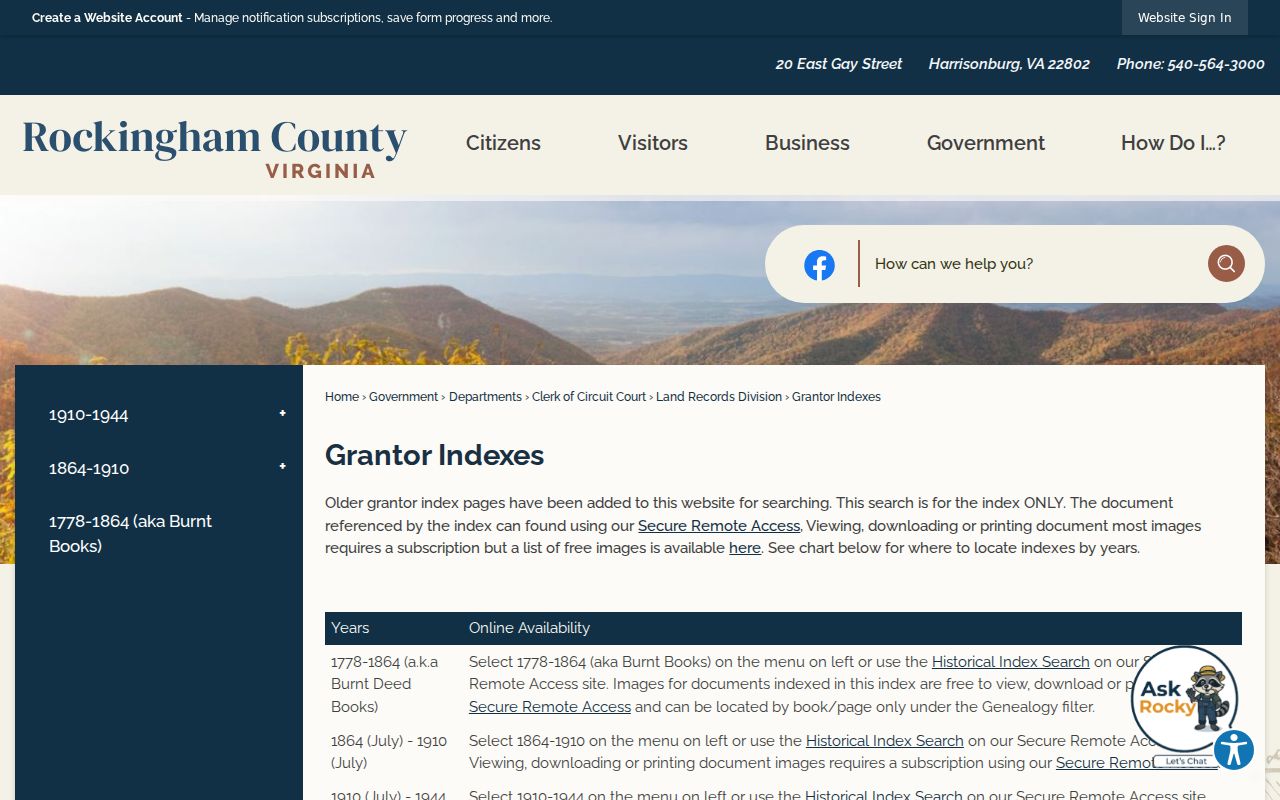
Use the chart to choose an index before searching for the image itself.
Walking the Rockingham Chain Backward
A chain of title strings together every deed for one tract of land. Rockingham indexes by grantor and grantee. Street addresses will not help. Take the current assessment owner as grantee. Open that deed. Its grantor becomes the next grantee one step back. The chain holds only with matching details. The legal description and parcel references must keep matching from deed to deed.
- Find the current owner's deed as grantee and note the recording date and book/page.
- Read the grantor, property description, acreage, and prior-conveyance reference.
- Search that grantor as grantee and repeat through earlier instruments.
- Move to the correct historical year group when the modern index no longer covers the transfer.
- Stop only when the parcel description or transfer path no longer matches, and then investigate the gap.
- Grantor
- The party who conveys an interest.
- Grantee
- The party who receives the interest.
- Chain of title
- The ordered set of recorded transfers for one parcel.
- Legal description
- The deed language that describes the land, often more stable than an address.
A quitclaim deed passes along whatever interest its grantor held, with no warranty of title. Indexes rarely spell that out. Read the full instrument type and legal description before treating every hit as an ordinary sale.
Rockingham Property Records to 1778
Rockingham County deed research starts with the Clerk's historical index. It reaches back to the county's 1778 record era. Free images for Deed Books 1-124 cover 1864 through 1923. The Burnt Deed Books span 1778 to 1864. The county also lists land grants from 1739 to 1827. Minute books, military records, the Estray Book, and Overseers of the Poor records round out the shelf. These collections enrich a house history. They are not all deed transfers, though.
Old property records demand patience. Spellings of a name can shift. A spouse may appear in parentheses. An early deed may describe a tract by its stream, road, acreage, or adjoining owner. A document may point to a parent farm instead of a modern lot. Link it through the deed's later conveyance clause and any recorded plat.
Histories Along the Blue Ridge, a collaboration between the Clerk and JMU, publishes selected collections. It also offers finding aids for material that has not been digitized. The Clerk's Genealogy and Burnt Books page gives the early volume history and book/page instructions.
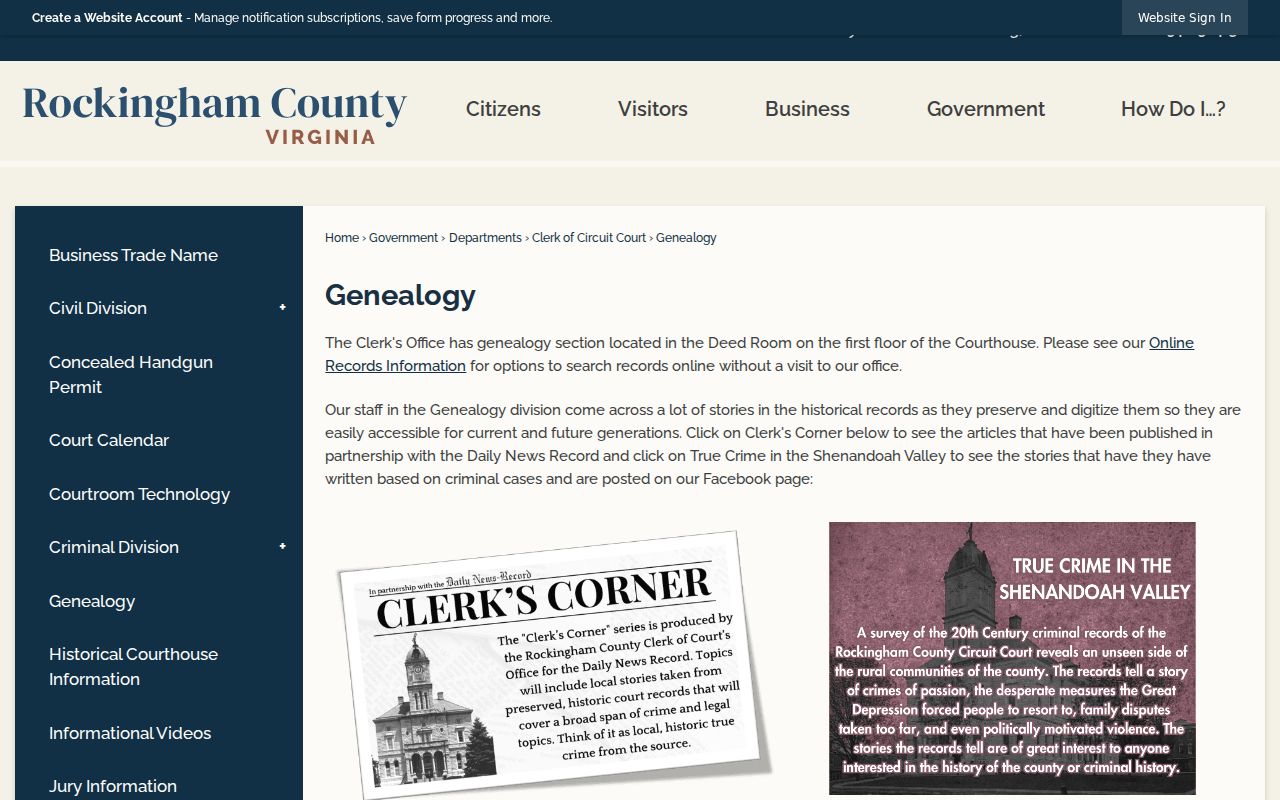
The genealogy page describes the surviving early books and the local record-preservation story.
How Rockingham's Burnt Books Survived
The Clerk's own account explains the name. During the Civil War, court records left the courthouse by wagon. A broken wheel stranded the load. Cavalry set it on fire. Two local women saved parts of the volumes with water and freshly cut clover.
That story accounts for the name Burnt Deed Books. Treat it as the Clerk's account, not a guarantee that every 1778-1864 transaction survived. For a gap in an early deed chain, check the index and image first. Then look for a later re-recording, a probate transfer, or a chancery suit.
A missing image proves little. The Library of Virginia's Chancery Records Index covers Rockingham cases through 1946. It includes a substantial image run from 1781-1913. Family history sources can explain a name, but ownership still rests on the land record.
Rockingham Index and Image Access
The SRA index itself is free to search. Remote viewing of images recorded after 1923 takes a paid subscription. The courthouse public stations show them at no charge, though. Subscriptions run $5.20 for 15 minutes, $31.20 for 30 days, or $374.40 for a year. Each price already includes the four percent credit-card surcharge. Free image access covers the earliest books. Book 1 through Book 124 fall in that free range.
Once the online index gives you a book and page, carry that reference to the courthouse. You can also carry it to the historical image tool. A miss on a name does not mean a miss on the record. Try alternate spellings. Try a spouse's or business name. Try the grantor list for that specific year. Before paying for a long remote session, ask the Clerk a question. Ask which collection holds the instrument you need.
Coverage splits across two systems. The modern SRA index starts in 1941. The county's historical grantor pages run from 1864 to 1944 and keep growing. That overlap is deliberate, since some years surface through either route. For a transfer in the early 1940s, check the modern index. Check the matching historical list too. Only then decide an older owner's entry is absent. The county's grantor-index year chart lays out how the historical groups are arranged.
Older index runs keep expanding. When a chain stops at a cutoff, revisit the county pages later.
Probate and Chancery Chain Gaps
A deed chain can shift course. An executor's deed, an administrator's sale, or a court order may explain a transfer that looks like a gap. A partition or a chancery decree can too. Rockingham probate staff handle wills and fiduciary qualifications. The Library of Virginia Chancery Records Index can reveal title fights or partitions among heirs. Boundary claims and estate property appear there as well. Court papers sometimes show why a later deed names a fiduciary rather than a relative.
To link a case file to the land record, use the decedent's name. Pair it with the parcel description you already know. A death certificate can fix a date. Access may be restricted. A public probate file and a recorded fiduciary deed remain separate records. Where online images fall short, the Clerk's genealogy room offers a documented alternative. So do the Histories Along the Blue Ridge finding aids. The Virginia Department of Health vital-records FAQ spells out certificate access. It also covers the public-opening periods for older records.
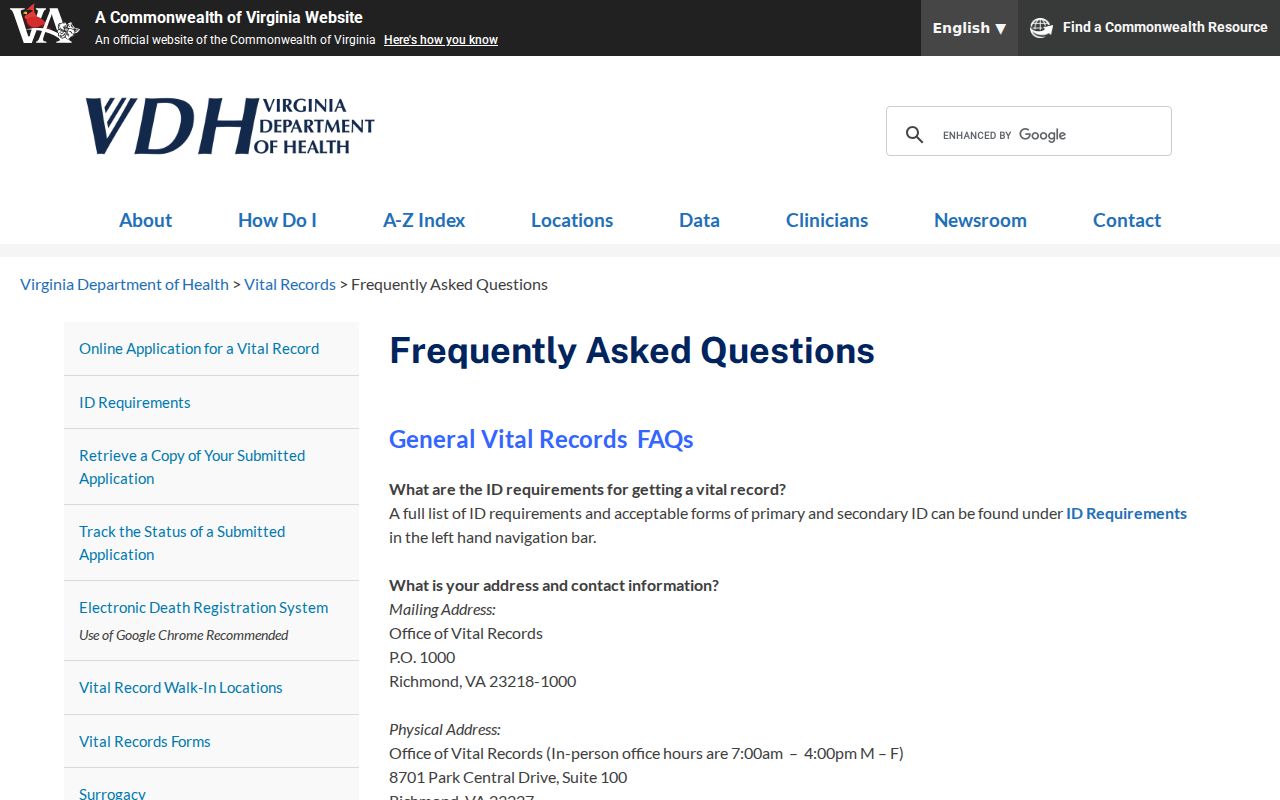
Build the timeline with vital records. Then confirm the transfer in the probate file and the recorded deed. Follow the actual instrument on each transfer rather than assuming inheritance from a family tie.
Rockingham Chancery Records and Owner History
A former owner's interest in land sometimes lives in a court dispute. It rarely sits in one clean deed. The Library of Virginia Chancery Records Index is cataloged through 1942 in part, but its coverage runs through 1946. Digitized images span 1781 to 1913 in the collection the county describes. Turn to it when a chain raises questions of partition among heirs. Come back for a boundary dispute, an estate, or competing claims to a tract. A case file may hold pleadings, exhibits, and a decree. That decree can explain why a later deed carries an executor's or commissioner's name.
Start from the parties and property language in the newest deed. Then search those older names in the index. Compare the case reference against the county land record. Court papers explain the dispute or the order. They do not replace a recorded conveyance on their own. If the file predates the online image range, ask the Clerk or the Library of Virginia where the paper record sits.
The Circuit Clerk's probate staff handle wills and fiduciary qualifications for Rockingham County at 540-574-4320. Keep that office's estate reference apart from the book and page used to request a deed copy.
Where Rockingham Owner History Ends
No single search window holds everything. Modern land records are indexed from 1941 forward, historical grantor groups cover 1864 through 1944, and free deed images reach from 1864 to 1923. The Burnt Deed Books begin in 1778. Indexing of older records continues. A chain can also branch through estate or court papers, or rest on a legal description older than today's parcel number.
Lawful use. Use Rockingham former-owner records for house history, title research, and property diligence. Do not use old or current owner details to track, harass, or harm anyone.
When the chain turns murky, lean on evidence that was recorded. The deed, probate file, chancery record, and recorded plat all outweigh a family story or a map shape.